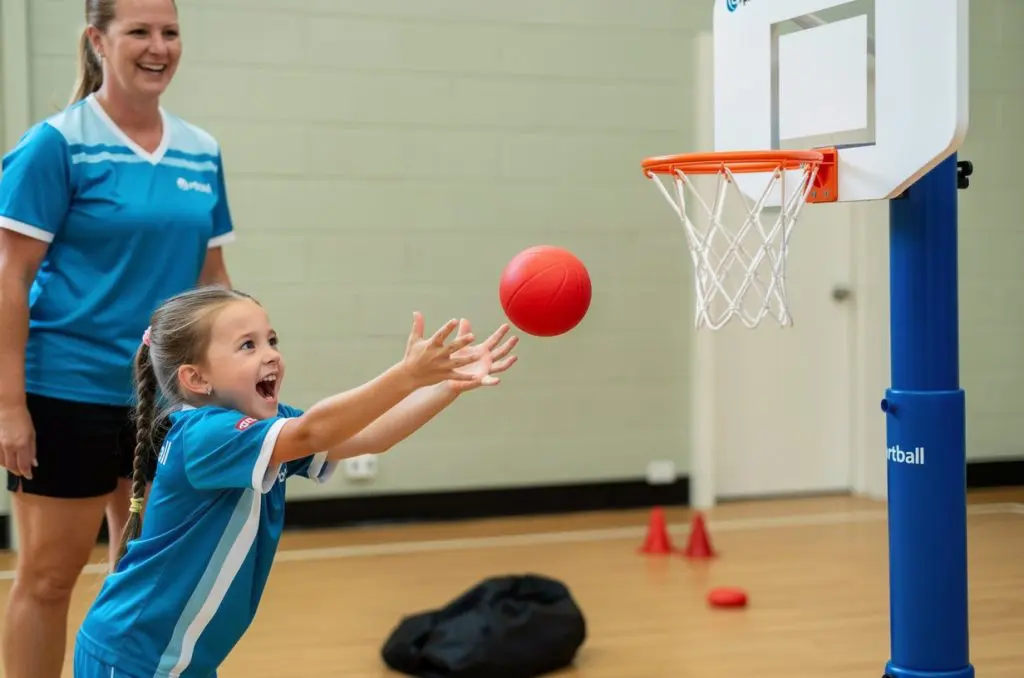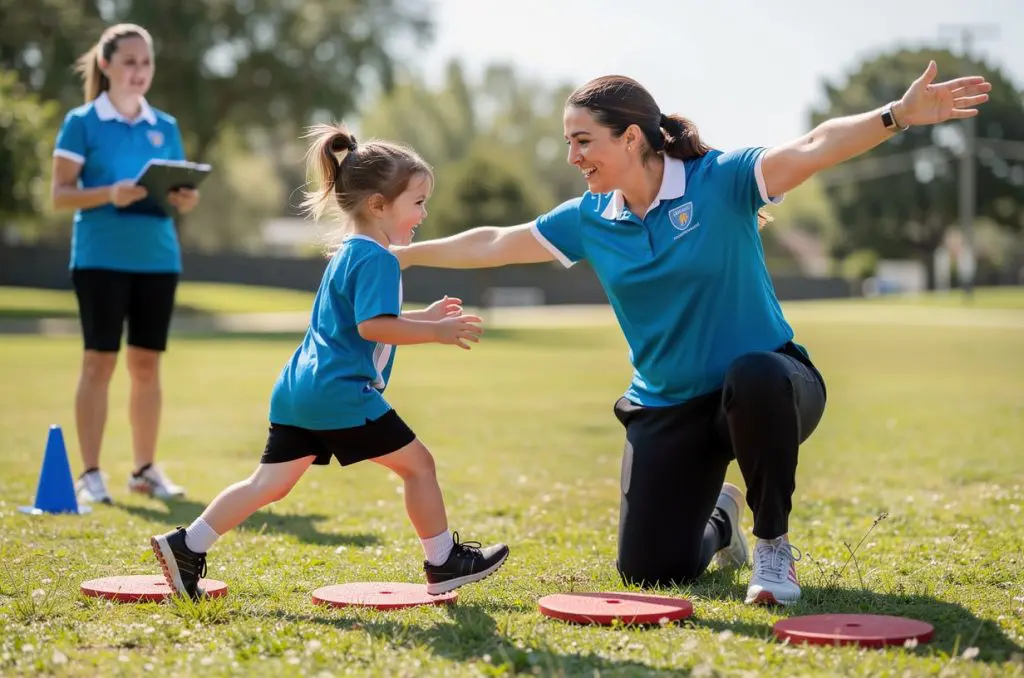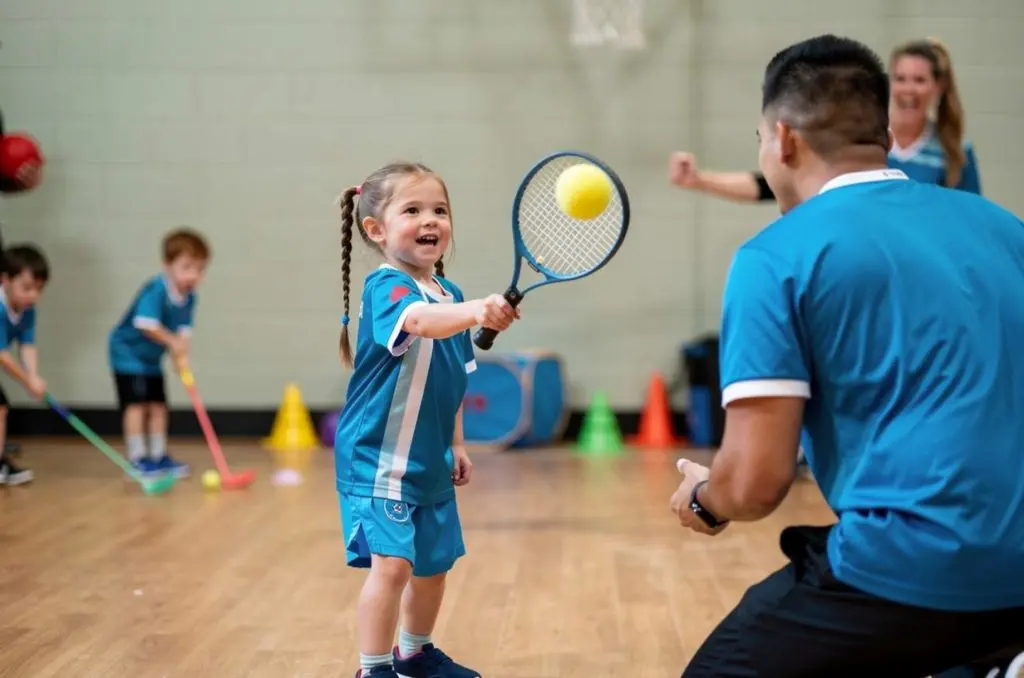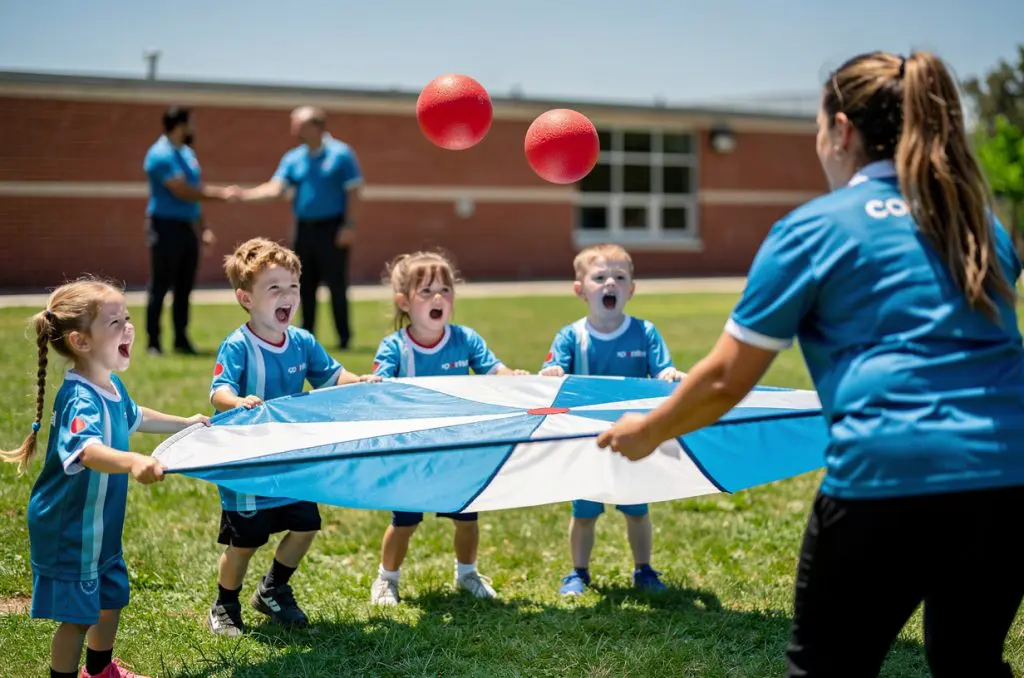
Sportball, Skyhawks, and SuperTots all teach more than one sport in partner venues instead of a dedicated gym, but they differ in program model, ages and how owners grow. We run one non-competitive, multi-sport class curriculum for children 16 months to 12 years in exclusive territories of about 400,000 people each. Skyhawks is built around camps, after-school programs, clinics, and leagues for school-age kids, SuperTots is its class brand for children 18 months to 5, and a buyer can take either brand or both in tiered territories of up to 250,000 people.
We are one of the three brands on this page, so we’ve kept to a rule: every Skyhawks and SuperTots figure below comes from Skyhawks’ own website, its franchise brochure, its Franchise Disclosure Document (FDD), or its Entrepreneur directory listing, with the source and year shown. Where those sources disagree, we show both figures. Where they’re silent, we say so.
The three brands at a glance
Skyhawks sources were checked in November 2026. All figures are in U.S. dollars.
| Sportball | Skyhawks | SuperTots | |
|---|---|---|---|
| Founded / franchising | Founded 1995 in Toronto; franchising since 2005 (Sportball, 2026) | Founded 1979 in Spokane, Washington (Skyhawks, 2026); current franchise model offered since January 2010 (Skyhawks FDD, 2026) | SoccerTots joined Skyhawks in 2014 (Skyhawks, 2026); SuperTots franchises offered by Skyhawks since April 2016 (Skyhawks FDD, 2026) |
| Program model | Multi-sport, non-competitive classes, plus camps, school and child care programs, parties, and events | Camps, after-school programs, classes/clinics, and leagues (Skyhawks FDD, 2026) | Classes/enrichment programs and birthday parties (Skyhawks FDD, 2026) |
| Ages | 16 months to 12 years | 4 to 14+ on the consumer site (Skyhawks, 2026); the FDD describes camps for ages 5 to 16 and other programs for 6 to 16 (2026) | 18 months to 5 years (Skyhawks, 2026; Skyhawks FDD, 2026) |
| Sports | Eight core sports rotated in one program: soccer, basketball, baseball/t-ball, football, hockey, volleyball, tennis, and golf | Ten listed in the FDD: baseball, basketball, cheerleading, flag football, golf, lacrosse, soccer, track & field, tennis, and volleyball (2026) | Six listed in the FDD: baseball, basketball, soccer, flag football, cheerleading, and hockey (2026) |
| Competition | Non-competitive; no scores or standings (Sportball FAQ, 2026) | “A fun and appropriately competitive environment” (Skyhawks FDD, 2026); leagues are part of the offer | Covered by the same FDD wording; SuperTots’ LinkedIn page describes “a non-competitive environment” (accessed 2026) |
| Facility | None. Shared spaces rented by the hour | None. Venues contracted “usually on a ‘lease per hour’ or ‘percent of fees per participant’ basis” (Skyhawks FDD, 2026) | |
| Territory | Exclusive; typically about 400,000 people (Sportball, 2026) | Tier 1: 150,000 to 250,000 people. Tier 2: under 150,000 (Skyhawks FDD, 2026). Described as exclusive on the franchise site (2026) | |
| Initial investment | $160,000: a $60,000 franchise fee plus $100,000 in operating capital (Sportball, 2026) | $30,300 to $89,750, with a franchise fee of $15,000 to $42,500 across three investment levels (Skyhawks franchise brochure, 2026). Entrepreneur lists $64,800 to $96,750 with a $49,500 fee (Entrepreneur directory, accessed November 2026) | |
| Ongoing fees | 8% royalty plus 2% ad fund fee on gross sales (Sportball, 2026) | Not published on the franchise site. Entrepreneur lists a royalty of “8%+”, an ad royalty of 0, and a $250 monthly technology fee (accessed November 2026). Check Item 6 of the FDD for any monthly minimum and local advertising requirement | |
| Training | 1 to 2 weeks in person, an 8-week launch program, and three months of Growth Coach mentorship (Sportball, 2026) | “Extensive training, marketing assistance, and ongoing support” (Skyhawks franchise brochure, 2026). About 36 hours of initial training, per a third-party summary of the 2025 FDD | |
| Technology | Sportball-owned registration platform, back-end admin, automated email, KPI reporting, and an AI assistant | Proprietary web-based software, “AT Connect,” with the license included in the initial franchise fee (Skyhawks FDD, 2026) | |
| Owner involvement | At least one full-time leader from day one; not for passive or semi-absentee investors (Sportball, 2026) | Home-based; part-time and absentee ownership listed as allowed (Entrepreneur directory, accessed November 2026) | |
Notes on sources: “Skyhawks FDD, 2026” refers to the business description excerpts of the 2026 Skyhawks Franchise Group disclosure document as hosted by Franchimp, a third-party FDD database. We could not find the document on Skyhawks’ own site, so request the current FDD from Skyhawks before relying on any figure here. Sportball figures come from our Franchise Information Report.
Program model
The clearest difference is what each business sells week to week.
Sportball sells a curriculum. In our signature multi-sport program, each class covers a different sport, so a child tries eight in a season. The same developmental approach runs through every format: parent-and-child classes, drop-off classes, school and child care programs, camps, birthday parties, and events. There are no scores or standings. The curriculum was developed with research institutions including the University of Toronto and The Children’s Hospital of Eastern Ontario and is organized around childhood development milestones, so each activity works on physical literacy, social skills, and sport skills together.
Skyhawks sells a menu of programs. Its franchise brochure lists “week-long summer day camps, year-round after-school programs, sport leagues, and clinics,” along with multi-sport programs, STEM Sports, and Mini-Hawk, and counts 12 program types. The FDD lists ten sports those programs can be delivered in and describes the coaching philosophy as “fun and appropriately competitive,” and leagues are part of the offer.
SuperTots is the early-years brand. Its program page lists sport-specific classes (SoccerTots, HoopsterTots, BaseballTots, 1stDownTots, HockeyTots, CheerTots, VolleyKats) plus Multi-SportTots, which introduces several sports. Parent participation is required in Multi-SportTots for ages 2 to 3.5, and SoccerTots introduces “friendly competition” at ages 4 to 5.
So all three are multi-sport at the brand level. The difference is that Sportball rotates sports inside one program, while Skyhawks and SuperTots offer named sport programs alongside a multi-sport option.
Ages
Sportball publishes one continuous range: 16 months to 12 years, under one brand and one franchise agreement.
Skyhawks covers a similar starting point and a higher ceiling, split across two brands. SuperTots serves 18 months to 5. Skyhawks’ consumer site lists ages 4 to 14+, and its franchise brochure says 4 to 14. The FDD text is older-skewing: camps for ages 5 to 16, and after-school programs, classes/clinics, and leagues for ages 6 to 16.
Two things follow for a buyer. If serving teenagers matters to you, Skyhawks’ published range goes higher than ours. And if you want toddlers through tweens, check what you’d be buying: the FDD says the franchise agreement states “whether you are purchasing a Skyhawks Business, a SuperTots Business, or both.” A Skyhawks-only purchase and a SuperTots-only purchase each cover part of the range.
Facility
None of the three needs a storefront. This is the area where the models are most alike.
Our programs run in school gyms, child care centers, community centers, churches, and parks, in shared spaces rented by the hour. That is how we reach 900+ program locations worldwide: those are partner venues inside franchise territories, not franchise units.
The 2026 Skyhawks FDD describes the same kind of arrangement, with programs at “sport and recreation facilities, churches, parks, schools and other similar venues” and for daycare centers, preschools, schools, and parks and recreation departments. Its franchise site counts more than 1,000 partner organizations, and the brochure describes owners “working from home.” Skyhawks also offers a Government Venue Franchise located at institutions such as schools, recreation departments, and military bases, which the FDD treats as a Tier 2 franchise that can’t add territories.
Territory and how owners grow
A Sportball territory is exclusive and typically covers about 400,000 people, with boundaries adjusted for geography or demographics in some cases. Owners grow inside it by adding coaches, programs, and venues. Some start with one coach and grow past 200. Several have gone on to add territories, including Matt Pearce, Mica and Alyssa Villalon, and the Richies. Our territories page lists the U.S. states where we’re currently offering franchises.
Skyhawks territories are tiered and smaller: 150,000 to 250,000 people for Tier 1 and fewer than 150,000 for Tier 2, according to the 2026 FDD text. Third-party summaries of earlier FDDs give different bands, so confirm the current ones with Skyhawks. Each franchise agreement covers one territory, and owners who want more sign an additional territory addendum. Owners can also grow by brand, holding Skyhawks, SuperTots, or both.
The practical trade-off: a larger territory gives more room to add venues before you need a second agreement, and it comes with a bigger market to staff and serve from day one. Compare Item 12 of each FDD for the exact rights, including what the franchisor reserves for itself.
Investment and fees
Our total is $160,000: a $60,000 franchise fee and $100,000 in operating capital, enough to run the business over its first several months. Ongoing fees are an 8% royalty and a 2% ad fund fee on gross sales. We don’t offer in-house financing.
Published figures for a Skyhawks franchise vary by source. The franchise brochure gives a total of $30,300 to $89,750, with a franchise fee of $15,000 to $42,500 and $8,500 to $20,550 in additional funds, and notes “3 levels of investment.” The franchise page shows a $42,500 fee. Entrepreneur’s directory lists a $49,500 fee and a $64,800 to $96,750 total, with a royalty of “8%+”, a $250 monthly technology fee, and a 30% veterans’ discount on the franchise fee. The FDD excerpts state that Skyhawks does not offer financing either. Ask Skyhawks which figures apply to the tier and brand you’re considering.
The totals aren’t built the same way. Most of the gap between our figure and theirs is working capital: ours carries $100,000, and the Skyhawks brochure carries up to $20,550 in additional funds. Whichever brand you choose, build your own runway for coach payroll, venue rentals, and living costs into the comparison.
On financial performance, our 2025 FDD Item 19 reports average gross sales of $270,686, a median of $215,604, and a high of $653,458. These are gross sales, not profit, and they don’t predict what a new territory will earn. We haven’t quoted a Skyhawks figure because the third-party sources we checked don’t agree on what its Item 19 reports. Read Item 19 in each brand’s current FDD side by side.
Training and support
Our training has three parts: 1 to 2 weeks in person on the Sportball methodology, an 8-week launch program called Sportball University, and three months of mentorship from a Growth Coach during setup, followed by ongoing one-to-one support and group sessions. Growth Coaches have run their own operations. Before any of that, our discovery process runs 12 weeks and has each prospect build and present a business plan. Coach training matters as much as owner training, because hiring coaches is the hardest part of running this business. Our coaches move through a four-level certification path from Rookie to Master.
Skyhawks’ brochure promises “a proven business model, extensive training, marketing assistance, and ongoing support,” and its process includes validation calls with current owners and a Discovery Day at headquarters in Spokane. Its franchise site doesn’t give training hours. A third-party summary of the 2025 FDD puts initial training at about 36 hours, 24 in the classroom and 12 on the job, delivered virtually or in Spokane. Item 11 of the current FDD has the detail. On timing, the brochure says opening a territory takes about three months on average, and the franchise site talks about launching a first program within six months. We typically see 2 to 6 months from first call to opening, which includes our 12-week discovery process, so the two timelines may not be measured from the same starting point.
Technology
Our technology is owned by Sportball and exclusive to franchisees: the registration platform at app.sportball.com, Sportball Central for CRM and payments, automated email, analytics and KPI reporting, and SportballGPT, an AI assistant for owners.
The 2026 Skyhawks FDD names a proprietary web-based platform, AT Connect, and says the license is included in the initial franchise fee. It describes the system as including “the technology to manage events, marketing and staff.” Entrepreneur lists a $250 monthly technology fee. Ask for a demo of both and see what a parent’s registration looks like on a phone.
Who each one suits
Sportball suits a full-time, community-minded owner who wants one developmental curriculum from toddler to tween, a larger territory to build out, and close coaching from someone who has run the business. A sports background isn’t required; most of our franchise partners come from business or child enrichment backgrounds. It is not a fit for passive or semi-absentee investors.
Skyhawks suits someone drawn to camps, leagues, and sport-specific instruction for school-age kids up to the mid-teens, with a lower published entry cost and a smaller territory. Skyhawks describes ownership as “an ideal career for former teachers, coaches and other professionals,” and Entrepreneur lists part-time and absentee ownership as allowed.
SuperTots suits an owner focused on children 5 and under, with classes and birthday parties, either on its own or paired with Skyhawks to extend the age range.
We’ve compared more brands in our guide to the best kids sports franchises and in Sportball vs Soccer Shots vs Amazing Athletes. If our model sounds like the right one, book a call with a Growth Coach and we’ll check your market.
Frequently Asked Questions
Is SuperTots separate from Skyhawks?
They are two brands offered by the same franchisor, Skyhawks Franchise Group. Its FDD says a buyer purchases a Skyhawks Business, a SuperTots Business, or both, and the franchise agreement states which. SuperTots serves children 18 months to 5 with classes and birthday parties; Skyhawks runs camps, after-school programs, clinics, and leagues for older kids.
How does Skyhawks’ cost compare?
Skyhawks’ 2026 franchise brochure gives a total estimated investment of $30,300 to $89,750, with a franchise fee of $15,000 to $42,500 across three investment levels. Entrepreneur’s directory lists $64,800 to $96,750 with a $49,500 fee. A Sportball franchise is $160,000: a $60,000 franchise fee plus $100,000 in operating capital. Confirm current figures in each brand’s FDD.
What ages does each brand serve?
Sportball serves children 16 months to 12 years in one program. SuperTots serves 18 months to 5 years. Skyhawks lists ages 4 to 14+ on its consumer site, and its FDD describes camps for ages 5 to 16 and after-school programs, classes, clinics, and leagues for ages 6 to 16.
Can you run either one part-time?
Sportball is designed as a full-time business and strongly recommends at least one full-time leader from day one; it isn’t built for passive or semi-absentee investors. Entrepreneur’s directory lists Skyhawks & SuperTots as a business that can be run part-time and from home, with absentee ownership allowed. Ask current franchisees of either brand how many hours they work.
This information is not intended as an offer to sell, or the solicitation of an offer to buy, a franchise. It is for informational purposes only. Within the U.S., we offer franchises solely through our Franchise Disclosure Document. Certain states regulate the offer and sale of franchises, and we will not offer a franchise in those states until we have complied with applicable pre-sale registration and disclosure requirements. Skyhawks and SuperTots are trademarks of their owner; figures for those brands are drawn from the sources linked above and may have changed.